

The “Share Everything” plan that turns into a business

Starting today, if you commit to sharing everything you know about a topic you’re hyper passionate about, you can finish 2026 with a small business you can keep improving.
The upside is basically unlimited. The downside is… what, exactly? You learn in public? Someone disagrees with you?
Here’s the twist: AI makes this commitment actually doable—not by “auto-generating content,” but by turning your brain into a system:
your ideas → into publishable output
your output → into leads
your leads → into email conversations
your email conversations → into offers
your offers → into data
your data → into better content (and better pricing)
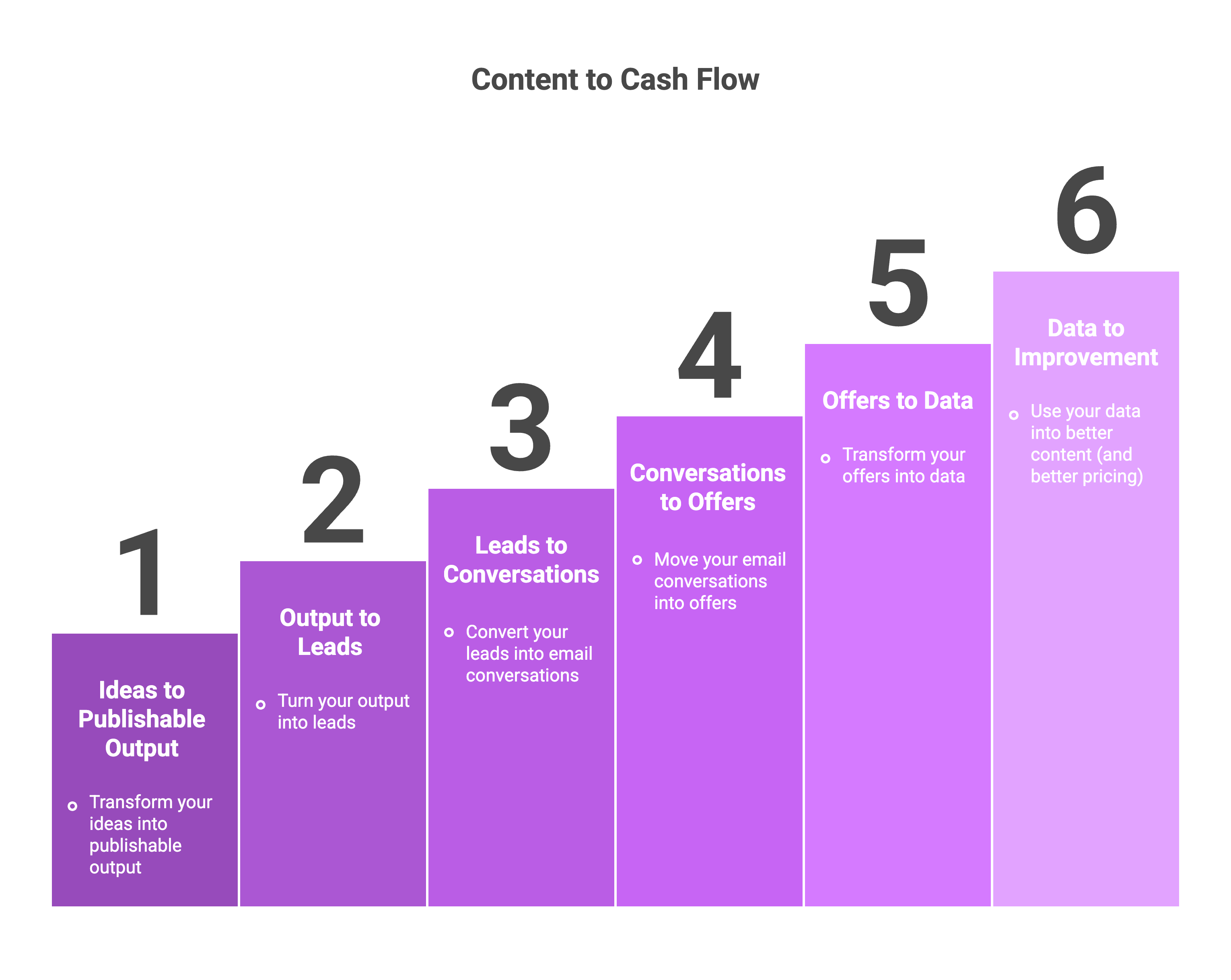
That loop is the business. AI helps you run it without losing your mind.
The real bet: compounding + systems (not virality + vibes)
Most people treat content like a lottery ticket:
post
pray
refresh
spiral
quit
A real business treats content like an asset pipeline. And AI turns “I should post more” into an operational reality:
You create once
You repurpose intelligently
You capture signals
You adapt the offer
You repeat
If you do that for a year, you don’t just “build an audience.” You build:
a searchable library of credibility
a lead engine (email list > follower count, sorry)
a product roadmap made of real customer questions
a moat: your experience + your point of view + your receipts
AI doesn’t create the moat. It helps you build it faster and maintain it longer.
Why “share everything” works now, specifically
The internet is getting flooded with content that reads like it was generated by a polite refrigerator.
Which means “more content” is not the move.
The move is: more specific, more grounded, more you.
And AI can help you get there—by doing the unsexy work:
organizing your thinking
outlining and structuring
turning one idea into multiple formats
building email sequences
tracking which topics actually convert
spotting patterns you can’t see when you’re tired
In 2026, the winners are not the people who post the most.
They’re the people who build the best content → email → offer loop.
Build the “Share Everything” Machine
Step 1: Pick a wedge topic (and let AI pressure-test it)
Not “marketing.” Not “fitness.” Not “AI.”
A wedge is narrow enough to be obviously relevant to someone.
Examples:
“Email marketing for therapists who hate selling”
“Strength training for postpartum moms with 20 minutes/day”
“AI workflows for 3-person agencies drowning in client work”
“Bookkeeping for creatives who fear spreadsheets”
Use AI like a positioning cofounder:
Ask it to generate 10 wedge options, then interrogate them.
Prompt:
“Here’s what I’m good at: ___. Here’s who I want to help: ___. Here’s the outcome I can get them: ___. Give me 10 wedge positioning statements. Then rank them by (a) clarity, (b) urgency, (c) ability to create paid offers quickly. Include what content I’d publish weekly for each.”
Now you’re not picking a niche based on vibes. You’re choosing a market angle with leverage.
Step 2: Create a CustomGPT (your “editor + strategist” that learns your brain)
This is where people either get powerful or cringe.
A CustomGPT shouldn’t be “write my posts for me.” That’s how you become Generic LinkedIn Slop #48,201.
Instead, build a CustomGPT that does things like:
forces clarity (“what’s the claim?” “who is this for?”)
preserves your voice
inserts better examples
asks for proof (so you don’t drift into guru-land)
generates repurposing variants that don’t sound like a bot
Give it:
your tone rules (what you won’t say, what you always do)
your audience + their pain points
your offer (even if it’s early)
your “beliefs” (your hot takes + what you refuse to do)
Your CustomGPT becomes your consistent thinking partner, not your ghostwriter.
Step 3: Turn your knowledge into a content flow (not random posts)
You need a system that produces content even when motivation is missing.
A simple content flow:
Capture: voice note or messy bullets daily
Synthesize: AI turns it into 3 possible angles
Publish: you pick one and add real examples + opinion
Repurpose: AI adapts into 5 formats
Route: each piece points to an email signup
Learn: AI summarizes replies + engagement into insights
This is a factory. A friendly factory. (A factory that makes trust.)
Minimum weekly cadence:
1 “pillar” piece (newsletter, blog, YouTube script, long LinkedIn post)
3–5 repurposed pieces (short posts, threads, carousels, clips)
AI isn’t replacing creativity. It’s replacing the blank page.
Step 4: Use agents for the parts you’ll otherwise “get to later” (never)
Agents are basically “automations with brains.”
You can set up light-weight agents to do things like:
Content agent
takes your weekly pillar and produces repurposed drafts
flags anything that sounds generic
generates headline options + hooks
Inbox agent
tags incoming replies by theme (pricing, confusion, objections, requests)
creates a weekly “customer language” doc (gold for marketing)
Research agent
collects relevant examples, screenshots, case studies, data points
feeds you “supporting material” so your writing stays concrete
Offer agent
looks at recurring questions and suggests paid assets
proposes: “turn this into a template / workshop / audit”
The point isn’t complexity. The point is reducing “mental overhead” so you keep publishing.
Consistency is a systems problem, not a willpower problem.
Email is where the business actually happens (and AI is your advantage)
Posting builds attention. Email builds revenue.
Because email lets you:
follow up
segment by intent
tell stories
make offers without begging an algorithm for mercy
Build an AI-assisted email strategy that doesn’t feel like a hostage note
1) Welcome flow (set expectations, build trust, route people)
A 5–7 email sequence that:
explains who you are and what you believe
teaches your “core framework”
shares 1–2 proof stories
asks a simple question (replies = data)
offers one clear next step
AI helps by drafting variants, tightening, and generating subject lines that don’t scream “MARKETING EMAIL!!!”
Prompt:
“Write a 7-email welcome sequence for [audience] who want [outcome]. Voice: direct, specific, slightly sarcastic, zero hype. Each email should include one practical takeaway and end with one question to encourage replies.”
2) Weekly newsletter that sells without being salesy
Structure:
1 story or observation (real life, client work, trend)
1 clear takeaway
1 practical step
1 soft CTA: reply / share / book / buy
AI helps by turning your messy notes into a clean narrative without removing your personality.
3) Segmentation (so you stop treating everyone the same)
Use links + tags:
“I want templates”
“I want done-for-you help”
“I’m just learning”
Then send different emails based on behavior.
AI helps by:
drafting segments’ content variations
summarizing which segment is converting
spotting where people drop off
Data examination: the part that turns content into a business, not a hobby
If you want to end 2026 with a business, you need to stop measuring “likes” like it’s a personality test.
Measure:
email signups per post
replies per email
consult calls booked
conversion rates by topic
revenue by content theme
time-to-first-purchase
And yes: AI can examine this without you living in spreadsheets.
What AI can do with your data (even if you’re small)
Identify your top converting topics
Extract repeated phrases people use (“I’m overwhelmed,” “I don’t know where to start,” etc.)
Detect objections that keep showing up
Recommend which offer to build next
Suggest content angles that map directly to revenue
This is how “sharing everything” becomes compounding: you don’t just publish—you iterate.
What you should sell first (AI helps you pick and package it)
Your first offer shouldn’t be a 47-module course you’ll never finish building.
Start with something:
fast to deliver
easy to test
tightly linked to your wedge
Best first offers:
Paid audit (with a written plan)
Template pack (scripts, checklists, swipe files)
Workshop (one topic, one outcome)
Done-with-you sprint (2 weeks, clear deliverable)
AI helps you:
package the offer clearly
write the landing page
generate FAQs and objection handling
create onboarding emails
turn delivery into reusable assets
Transactions create truth. AI helps you get to transactions faster.
A weekly workflow that’s actually sustainable (with AI embedded)
Monday (30 min): Capture + choose
voice note your ideas
AI turns it into 10 possible posts
you pick one pillar
Tuesday (60–90 min): Draft pillar
AI outlines 3 angles
you write the stance + examples
AI tightens and removes fluff
Wednesday (20 min): Publish + route
post + send email
one CTA to your list or lead magnet
Thursday (30 min): Repurpose + schedule
AI generates 5 short pieces
you edit for voice and specificity
schedule them
Friday (20 min): Data + insights
AI summarizes replies/comments into themes
you log: what converted, what confused, what sparked demand
pick next week’s topic based on reality
That’s it. That’s the loop.
The “almost zero downside” truth
Worst case, you publish for a year and:
get clearer on what you believe
build a library of useful work
improve your communication
learn what the market actually wants
make future offers easier to sell
Best case, you end 2026 with:
an audience that trusts you
an email list that converts
a validated offer
a repeatable system
a business you can improve forever
The only real risk is disappearing because you tried to do it “manually” and burned out.
AI doesn’t make you better.
It makes you consistent. And consistency makes you better.