

How to Align Your Message With What Customers Really Want


There’s a pattern that quietly sits underneath so many campaigns, launches, posts, emails, and strategies that “should have” worked — but didn’t.
Most marketing problems aren’t creative problems.
They’re not strategy problems.
They’re not budget problems.
They’re not even awareness problems.
They’re alignment problems.
Somewhere along the way — sometimes subtly, sometimes dramatically — one of three things drifted:
the audience
the promise
the moment
When even one of these is misaligned, the entire system feels harder than it should:
You post more but see less.
You optimize but nothing moves.
You get attention but no action.
You get likes but not buyers.
People say “hmm… interesting” instead of “I need this.”
It’s not because your work is bad.
It’s because something in the system isn’t lining up the way you think it is.
And misalignment can’t be out-hustled.
Let’s break this down.
1. The Audience Problem
Sometimes the audience isn’t wrong — it’s just not the one you meant to speak to.
This is the misalignment most people never diagnose.
Here’s what it looks like:
You get engagement from people who were never going to buy
You attract the curious, not the committed
Your DMs fill with the wrong questions
You get traffic… but not qualified traffic
“Someday people” show up instead of “today people”
Maybe your message is attracting people who want inspiration instead of implementation.
Or beginners instead of decision-ready buyers.
Or people who like your content but don’t need your product.
The messaging isn’t broken —
it’s just speaking to someone you didn’t intend.
This is fixable, but only if you can see it.
2. The Promise Problem
A product can be incredible and still fall flat if the promise doesn’t land.
The promise is what someone believes will change once they buy.
When the promise is fuzzy, too small, too big, or misaligned with what someone actually wants, you feel the friction immediately:
People hesitate
People bookmark but don’t buy
People ask “so… what does this actually do?”
People show interest, but not urgency
People expect something different than what you deliver
There’s nothing more uncomfortable than watching someone want your product…
but not trust that it will create the change they’re hoping for.
That’s a promise issue — not a product issue.
3. The Moment Problem
This is the one almost no one talks about.
Sometimes the message is right, the audience is right, the promise is right…
but you sent it at the wrong moment.
Moment misalignment looks like:
People are busy
People are in the wrong emotional state
People are in the researching phase, not the buying phase
People aren’t ready to admit they need the thing yet
People are interested, but not available
People are too early, or too late in their decision cycle
This is the part marketers underestimate:
Timing isn’t just a posting strategy. It’s a psychology.
A message that would work beautifully tomorrow might fall flat today.
A message that worked last month might not land this month because your audience’s emotional landscape shifted quietly underneath you.
Most marketing “failures” are mis-timed success.
Why Alignment Matters So Much
When audience + promise + moment lock into place, everything feels different.
Your work feels lighter.
Your content resonates faster.
People don’t hesitate — they recognize themselves instantly.
Your message lands where it’s supposed to land.
Results start to flow without force.
Good marketing doesn’t feel like pushing.
It feels like meeting someone at the exact moment they say:
“Yes. This is what I’ve been looking for.”
And this is where AI becomes incredibly helpful — not as a writer, but as your clarity tool.
Where AI Actually Helps (The Real Value)
Most people think AI helps you “write faster.”
Sure, it can — but that’s not the interesting part.
The real power of AI in marketing is that it helps you catch the misalignment long before you would have noticed it.
It improves perception, not production.
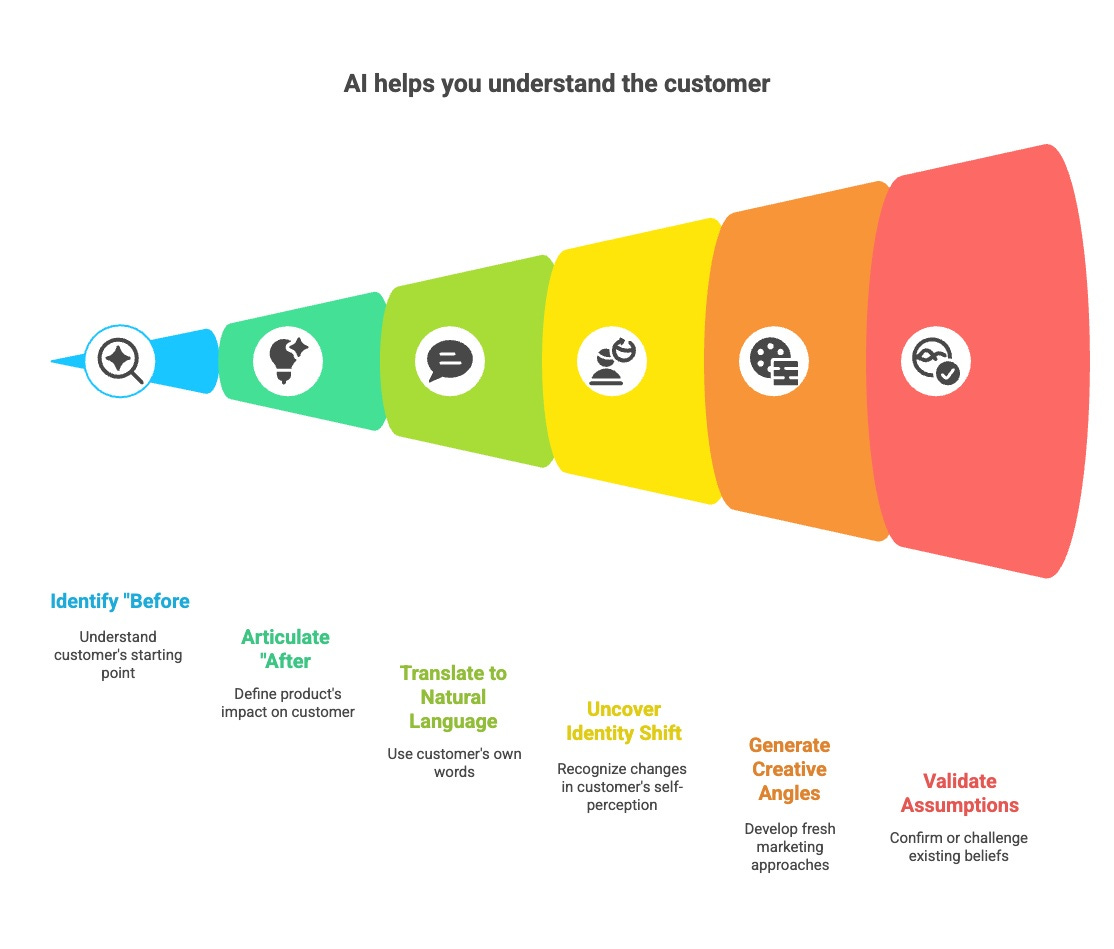
Here’s how:
1. AI helps you identify the real “before” your customer is living.
You stop guessing.
You start understanding the emotional and practical state someone is in before they buy.
2. AI helps you articulate the real “after.”
The improvement someone feels — not the one you assume they feel.
3. AI translates those shifts into natural language.
Words customers actually use, instead of marketing terminology.
4. AI uncovers the identity shift behind the purchase.
Not what someone buys — but who they’re trying to become.
5. AI gives you new angles and helps you escape creative ruts.
It breaks the monotony and reveals perspectives you lost sight of.
6. AI uncovers the phrases customers already use.
The exact words people type into search, reviews, texts, and DMs.
7. AI validates or challenges your assumptions.
It confirms what’s true — or exposes what isn’t.
8. AI reveals the deeper emotional “why.”
The hidden need behind the purchase: control, relief, calm, confidence.
This is the alignment advantage.
Now let’s get into the prompts.
The Alignment Check (With High-Precision AI Prompts)
These are not writing prompts.
These are diagnostic prompts — designed to reveal blind spots.
Use them anytime something feels off.
Audience Alignment Prompt
Use this to see who your message is actually resonating with.
Prompt:
“Analyze the following marketing message and identify which audience it actually speaks to, based on tone, problems referenced, emotional drivers, and assumed level of awareness.
Break your response into:
The audience this message unconsciously targets
The audience it claims to be targeting
The gap between those two audiences
What this misalignment would look like in real behavior
Three audience mindsets my message currently resonates with
How to realign the message to the audience I intended
Any blind spots or assumptions I’m making
Here is the message: [paste your copy].”
Promise Alignment Prompt
Use this to uncover the real promise someone walks away with.
Prompt:
“Read the following copy and identify the actual promise it communicates.
Break your analysis into:
What the copy says the product does
What the copy actually promises will change
The emotional promise underneath the practical one
Any mixed signals or vague promises
What the customer would realistically expect after reading
Where the promise is unclear, too big, or too small
How to articulate the true promise more clearly
A one-sentence distilled promise based on what people care about
Here is the copy: [paste here].”
Moment Alignment Prompt
Use this to understand whether your message hit at the right time.
Prompt:
“Analyze the message and determine whether it matches the customer’s decision stage.
Break your analysis into:
The decision stage this message speaks to
Why it fits that stage
Where the timing feels off
What the customer needs emotionally at this moment
Signals they may be at a different stage
How the message would land if sent earlier or later
A version of the message that matches the actual stage
How to realign timing for better results
Here is my message: [paste here].”
The 3-Part Master Alignment Prompt
For when you want one full scan.
Prompt:
“Evaluate my message for alignment across:
A. Audience
B. Promise
C. Moment
Tell me:
Who I’m really speaking to
What I’m really promising
Where the timing is off
What needs to shift
How to realign everything
Here is the message: [paste it].”
Remember
Most marketing doesn’t fail because the content is wrong.
It fails because the alignment is off.
Audience.
Promise.
Moment.
When those three lock into place, marketing stops feeling like force —
and starts feeling like resonance.
AI is simply the tool that helps you see the misalignments earlier,
fix them faster,
and understand your customer more clearly than you ever have.
That’s the shift.