

How AI characters on Instagram could change brand conversations
How AI characters work, why they matters and how businesses could use it

Most people hear “AI character on Instagram” and picture a fake influencer. In reality, it usually means something much more practical: a chat-based AI inside Instagram that can answer questions, recommend products, and help creators or businesses respond faster.
What Is an AI Character on Instagram?
An AI character on Instagram is usually an AI that people can message inside the app. Instead of sending a question to a brand or creator and waiting hours for a reply, a user can interact with an AI built to respond right away.
Depending on how it is set up, that AI might act like a general assistant, a product guide, a brand concierge, or an extension of a creator’s voice.
This is where the phrase can throw people off. “AI character” sounds like a made-up digital personality posting content. In many cases, it is much simpler than that. It is a conversational tool inside Instagram that helps people get answers, suggestions, or direction faster.
“An Instagram AI character is less about pretending to be human and more about helping people get what they need faster.”
How Instagram AI Characters Work
The simplest way to think about Instagram AI is as a fast first response.
A person sends a message.
The AI answers a common question.
It suggests an option, points to the right information, or helps narrow down a choice.
If the situation gets more complicated, a human can step in.
That is the practical use case.
An Instagram AI character can be built around a specific role. It might help someone choose the right product, answer visitor questions, explain a service, recommend a room type, or suggest what to do next.
The clearer the role, the more useful the AI tends to be.
Meta AI vs. Custom AI vs. Creator AI on Instagram
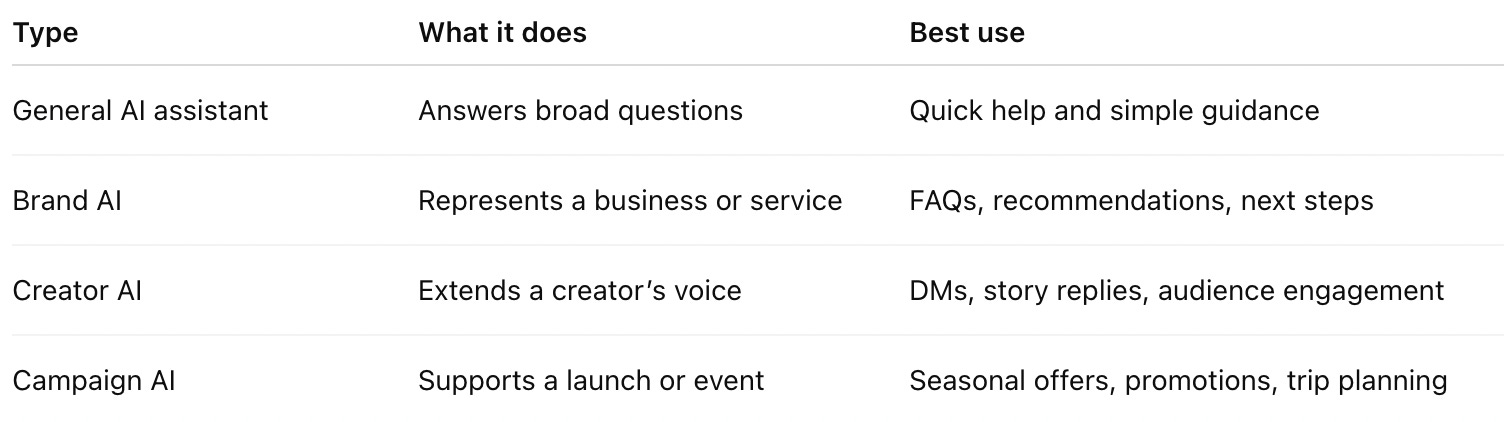
Part of the confusion comes from the fact that people are often talking about different kinds of AI without realizing it.
Some AI experiences are built into Meta’s ecosystem more broadly. Others are created for a particular purpose. Others are designed to reflect a creator’s content and audience.
Here is the easiest way to separate them.
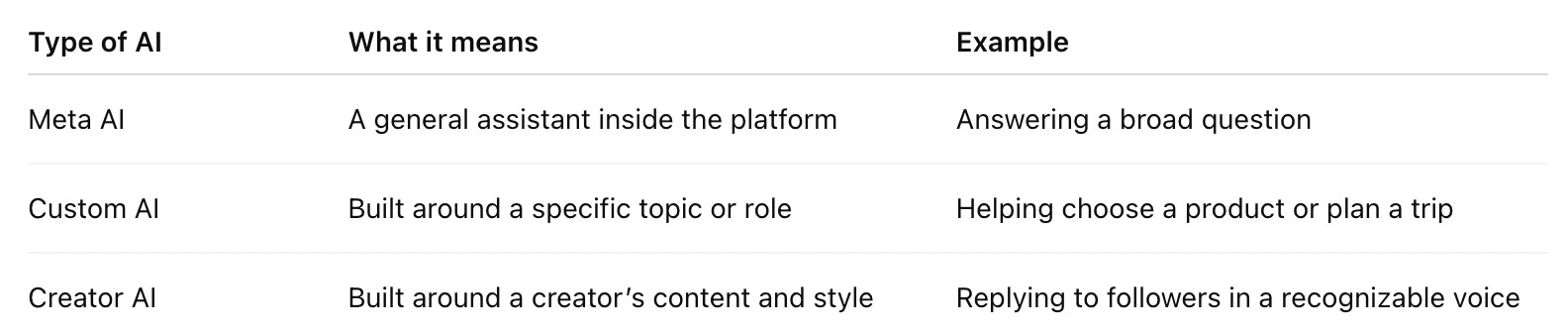
For readers, the easy version is this: Meta AI is the general assistant, custom AI is built for a specific job, and creator AI is meant to extend one person’s presence.
For businesses, that distinction matters. They do not need to build “an AI character” just because the term sounds new. They need to decide what kind of AI interaction would actually help people.
“The businesses that benefit most will not be the ones with the flashiest AI. They will be the ones with the clearest use for it.”
Why Instagram Is Moving in This Direction
People already use Instagram to discover restaurants, compare hotels, save destinations, watch walkthroughs, send links to friends, and ask questions in DMs.
Adding AI to that behavior makes sense.
Instead of pushing people to leave the app, search through a website, or wait for a reply, Instagram can keep the interaction moving in one place. For users, that can mean less friction. For businesses, it can mean fewer missed messages, faster replies, and more chances to turn interest into action.
How Businesses Can Use AI Characters on Instagram
This is where the feature becomes more than a curiosity.
Most businesses do not need an AI character for novelty. They need it to do a job.
The strongest use cases are practical, visible, and easy for customers to appreciate right away.
Use Instagram AI to Answer Common Questions Faster
This is the most obvious use, and probably the most useful.
Many businesses get the same questions over and over:
What are your hours?
Do you take reservations?
Do you ship?
Is this family-friendly?
Where should I park?
Which product is best for beginners?
Do I need a ticket in advance?
A good AI character can handle that first layer of questions right away.
That matters because speed affects behavior. When someone gets an answer quickly, they are more likely to keep moving toward a purchase, booking, or visit.
Use Instagram AI for Product or Service Guidance
This is where AI starts doing more than answering FAQs.
A business can use AI to help people make decisions.
A skincare brand could guide someone toward the right routine.
A hotel could explain which room works best for a romantic weekend versus a family stay.
A museum could suggest the best experience for visitors with limited time.
A restaurant could recommend dishes based on mood or dietary preferences.
That kind of interaction can reduce hesitation. Instead of making the customer do all the work, the business helps move them from interest to choice.
Use Instagram AI to Extend a Founder or Creator Voice
For founder-led businesses and creator-led brands, this may be one of the more interesting use cases.
A creator or founder often becomes part of the product experience. People are not just buying the offer. They are buying the perspective, taste, or expertise behind it.
AI can help extend that presence.
A chef could use AI to explain the menu and offer dish suggestions.
A stylist could use AI to help people choose looks for different events.
A travel creator could use AI to suggest itineraries.
A local expert could use AI to recommend places based on the kind of day someone wants.
When this works, it does not feel like the person has disappeared. It feels like their guidance is more available.
Use Instagram AI for Launches, Campaigns, and Seasonal Promotions
Not every AI needs to be permanent.
Businesses can build AI experiences around a single campaign, event, or season. In some cases, that may be the smarter starting point because the purpose is easier to understand.
Examples include:
a holiday gift guide assistant
a summer travel planner
a museum exhibit guide
a back-to-school shopping helper
a restaurant week assistant
a holiday lights local guide
a hotel weekend package planner
These are easier for people to engage with because the AI has one clear job.
Use Instagram AI Like a Concierge
This is especially promising for local businesses and tourism-related brands.
A hotel could suggest restaurants, museums, and nearby stops.
A car rental company could recommend scenic drives and easy day trips.
A museum could explain how to pair a visit with lunch or another cultural stop.
An amusement park could help guests think through timing, rides, and age-appropriate planning.
At that point, the AI starts to feel less like a support bot and more like a simple concierge.
“The best AI on Instagram will probably feel less like technology and more like helpful direction at the right moment.”
How Hotels, Museums, Restaurants, and Amusement Parks Could Use Instagram AI
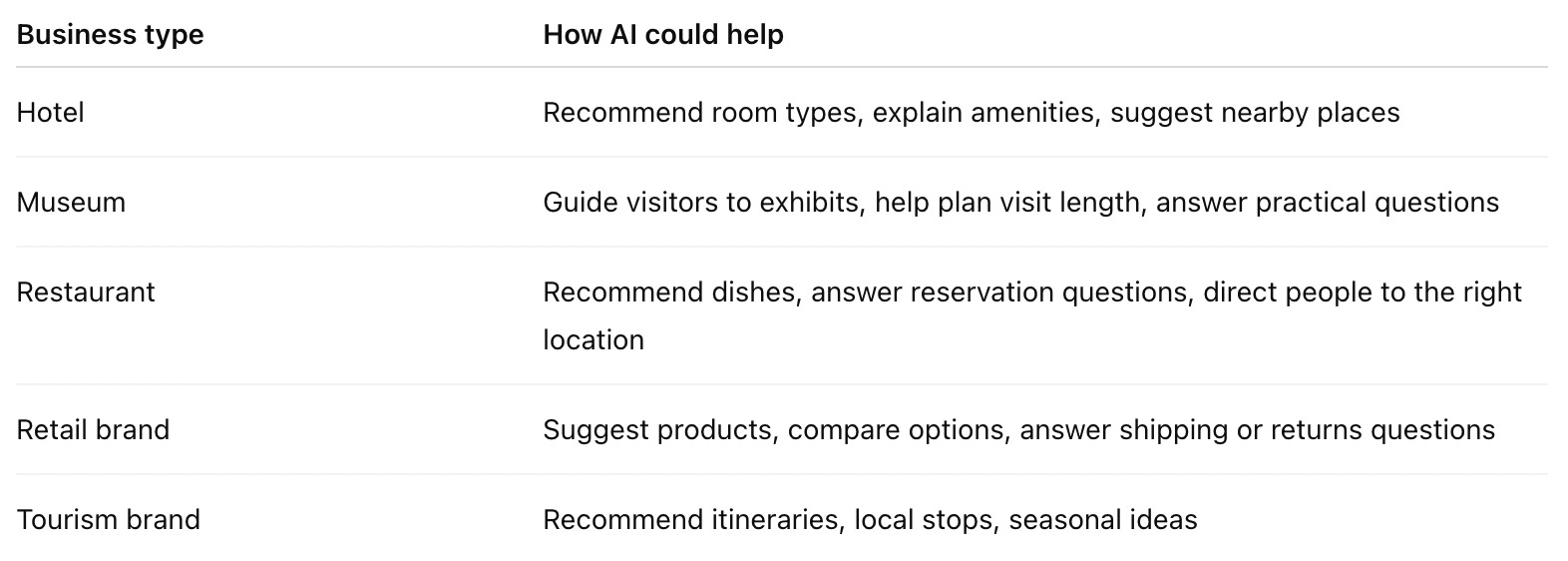
Some business categories are especially well-suited for this because people already ask them a lot of questions before they commit.
Hotels
Hotels could use AI to:
explain room types
answer parking and check-in questions
suggest nearby attractions
recommend packages
help guests decide whether the property fits their trip
Museums
Museums could use AI to:
guide people toward the right exhibit
help families plan visits
explain what is currently on view
answer timing and accessibility questions
pair the museum visit with nearby activities
Restaurants
Restaurants could use AI to:
answer reservation and parking questions
recommend dishes
explain atmosphere and seating
suggest the best time to visit
guide people to the correct location
Amusement Parks
Amusement parks could use AI to:
help families plan around ages and interests
explain ticket or timing questions
suggest food options
simplify pre-visit planning
answer common logistics questions
Tourism Brands
Tourism brands could use AI to:
suggest day trips
build itineraries
recommend seasonal activities
guide people by mood or travel style
answer visitor basics quickly
How Instagram AI Could Support Sales, Bookings, and Discovery
A lot of people drop off not because they are uninterested, but because they hit friction.
They see a hotel they like, but do not know which room to book.
They find a museum, but are unsure whether it is worth the drive.
They come across a restaurant, but cannot tell whether it fits the occasion.
They see a destination, but do not know how to turn it into a workable plan.
That is where AI can help.
It keeps the person moving instead of making them stop, dig around, compare options, and possibly leave.
AI won’t close every sale, but it will can reduce the small questions that slow people down.
Where Businesses Could Get Instagram AI Wrong
This part matters just as much as the opportunity.
Making It Sound Generic
If the AI sounds stiff, vague, or overly polished, people will notice quickly. No one wants to message a business and get a response that sounds like a brochure.
The point is not to sound impressive. The point is to be useful.
Trying Too Hard to Sound Human
If the AI starts feeling deceptive, trust drops. People do not need the AI to pretend it is a person. They need it to be clear, direct, and honest about what it can do.
Using It in the Wrong Moments
AI is a good fit for:
common questions
recommendations
basic planning
product guidance
visitor information
AI is a weak fit for:
complaints
refund problems
emotionally charged issues
unusual edge cases
situations that require care or judgment
The best setup is not AI instead of humans. It is AI for the first layer, then human support when needed.
Giving It Too Many Jobs
This is one of the biggest mistakes a business could make.
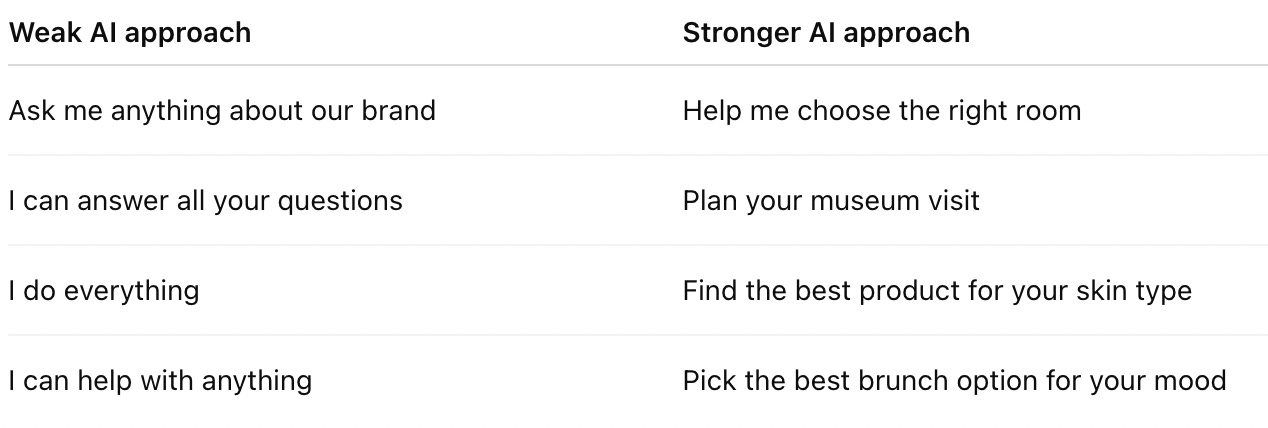
A broad AI often becomes a bad AI. The more focused the role, the more likely the experience feels helpful.
How Consumers Might Respond to AI Characters on Instagram
Consumers will not all react the same way.
Some people will like the convenience right away. If they already use Instagram as a place to browse and ask questions, AI may simply feel like a faster version of what they are already doing.
Some people will be cautious. They may worry that brands are becoming less human or harder to reach.
Some people will ignore the feature unless it clearly helps them.
And some people will test it the second they see it. They will ask weird questions, try to confuse it, or see whether it gives lazy answers.
That is normal.
The real question is not whether people like the idea of AI in the abstract. The real question is whether the interaction feels helpful.
“Most people will not care that a business used AI. They will care whether the answer was useful.”
Will People Trust AI Characters on Instagram?
Trust will come down to execution.
People are more likely to trust the experience when:
the AI is clearly identified
the answers are fast
the information is accurate
the business makes it easy to reach a human
the AI stays in its lane
People are less likely to trust it when:
it sounds fake
it dodges straightforward questions
it keeps looping
it gives wrong information
it feels like a wall instead of a guide
This is why usefulness matters so much. Consumers do not need the experience to feel magical. They need it to feel worth their time.
What Businesses Should Do Before Launching an Instagram AI Character
Before building anything, businesses should look at the messages they already receive.
That is where the real use case is hiding.
Start with questions like these:
What are people already asking us in DMs?
Which of those questions come up repeatedly?
Where do people get stuck before they buy, book, or visit?
What can be answered quickly and clearly?
When should the AI stop and a human take over?
The strongest AI characters are built around real customer friction, not hype.
Which Businesses Are Best Suited for Instagram AI Characters?
Businesses that already get a lot of discovery traffic and repeat questions are probably the best fit.
That includes:
hotels
restaurants
museums
tourism boards
amusement parks
retail brands
beauty brands
service businesses
creator-led brands
local businesses with active Instagram audiences
These categories all have something in common: people are interested, but they often need one more piece of information before they act.
That is where AI can help.
AI Characters on Instagram
An AI character on Instagram is not just a trendy phrase. It points to a real shift in how people may start interacting with brands, creators, and recommendations inside the app.
For businesses, the opportunity is not to create something flashy and call it innovative. It is to make Instagram interactions easier, faster, and more useful.
For consumers, the standard will be simple. If the AI saves time and helps them make a decision, they will use it. If it feels clunky, vague, or unnecessary, they will move on.
That is what will separate the useful AI characters from the ones people forget.
“The businesses that win with Instagram AI will not be the ones chasing novelty. They will be the ones removing friction.”