

Don’t Optimize Yet


You can’t optimize the software on a computer that’s overheating and has no battery life.
The same is true for your marketing plan.
Marketers love optimization. We tweak, automate, and A/B test because those things feel like progress.
But when the foundation is unstable, optimization becomes noise disguised as productivity.
No amount of automation, dashboards, or clever AI prompts can fix a marketing system that is running on low energy and high confusion.
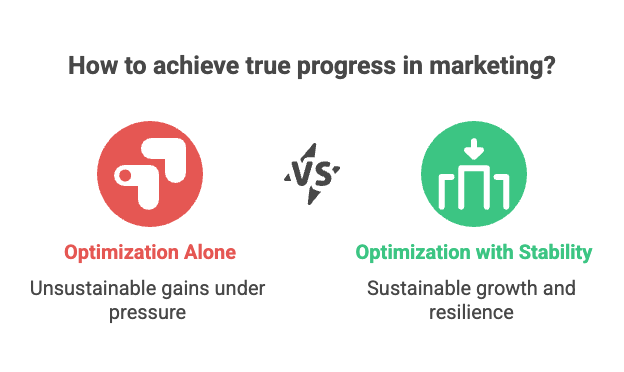
Before you optimize, you have to stabilize.
The Marketing Equivalent of an Overheating Computer
When your computer starts slowing down, your instinct is to close apps, delete files, or restart it.
But if the fan is still roaring and the battery warning light keeps flashing, none of that helps.
In marketing, the same thing happens. You might pour hours into new campaigns or invest in another AI tool, but if your system—the strategy that holds everything together—is overheated, you are compounding inefficiency.
Here is what that looks like in real life:
You are running five campaigns but cannot explain what success actually means for each one.
You are tracking KPIs without knowing how they connect to business outcomes.
Your team is working at full speed but on disconnected goals.
Your messaging keeps changing because no one is sure what the brand stands for.
You have added new AI tools that solve tactical problems but create strategic noise.
This is what happens when you optimize too early.
It is like installing new software on a computer that is about to crash.
Step One: Recharge Before You Optimize
When a device loses power, you do not install updates. You plug it in first.
The same principle applies to your marketing system.
If your brand, team, or message is depleted, you need to recharge before layering in complexity.
Start by asking:
Is our strategy current? Has it evolved with shifts in the market, audience behavior, or competitors?
Is our data clean and connected? If AI is reading bad inputs, it is producing bad insights.
Are our goals realistic based on our current capacity?
Does our content still reflect what customers care about today, not six months ago?
Once you identify weak spots, refocus your energy on clarity instead of complexity.
Prompt to use:
“Act as a marketing systems consultant. Review this campaign overview: [insert text]. Identify where the plan shows signs of instability, misalignment, or resource strain. Suggest a three-step plan to strengthen the foundation before using AI for optimization.”
A fully charged system is strategic oxygen. Without it, every optimization effort is wasted energy.
Step Two: Cool the System
Computers overheat when they are overworked.
So do marketing teams.
If you are producing faster than you are thinking, your system is too hot to process new ideas clearly.
Cooling down means slowing the pace long enough to assess which actions actually create value.
Ask yourself:
What are we doing because it works, and what are we doing because it is habit?
Which metrics truly reflect business impact, not vanity success?
Where are we duplicating efforts across teams or platforms?
AI can help you identify friction points that humans have normalized.
Prompt to use:
“Analyze the following workflow: [insert details]. Identify where output exceeds capacity, where repetition occurs, and where automation could reduce stress without sacrificing quality.”
Cooling the system creates mental bandwidth.
That is when strategic thinking returns.
When your internal CPU stops overheating, you start seeing connections instead of chaos.
Step Three: Optimize What Is Stable
Once your system is recharged and cooled, you can finally optimize.
That is when AI transforms from a troubleshooting tool into a growth engine.
Optimization is about precision. It is the refinement phase where energy compounds instead of disperses.
Focus on three key areas:
Efficiency
Use AI to streamline repetitive tasks like copy variants, scheduling, and data analysis.
This does not replace people; it frees them to think creatively.
Prompt: “Identify tasks within this marketing plan that could be automated using AI without reducing creative quality or insight.”
Consistency
Alignment is what separates brand equity from brand noise.
Use AI to audit voice, tone, and message across every channel to ensure every piece feels like it came from the same place.
Prompt: “Audit this brand’s social, email, and web copy for tone consistency. Highlight inconsistencies and suggest edits for unified messaging.”
Intelligence
Predictive AI helps you see what is coming before it shows up in your metrics.
Forecasting content performance or customer churn allows you to adjust proactively instead of reactively.
Prompt: “Based on this historical data, predict which campaign segments are likely to underperform next quarter and recommend optimizations to improve ROI.”
Optimization only amplifies what already works.
If the foundation is unhealthy, AI will magnify the dysfunction.
The Human Parallel
Every marketer knows the temptation to do more.
But even the best system crashes when it is overextended.
This is where leadership meets sustainability.
You would not push your team to run faster if they were burned out, so do not push your marketing system past its limits either.
A healthy, well-maintained system does not need frantic optimization. It evolves smoothly because the environment supports it.
That is the difference between managing a machine and nurturing an ecosystem.
The AI Perspective
AI is not your mechanic. It is your monitor.
It does not fix broken strategy; it exposes it.
When AI tools show inconsistent data, irrelevant recommendations, or off-brand outputs, that is not a software glitch. It is a mirror reflecting strategic misalignment.
The best marketers do not rush to fix AI when it behaves unpredictably.
They examine what it is revealing about their own system.
Ask yourself:
Are our brand inputs inconsistent?
Are we training AI on outdated materials?
Are we asking AI to optimize confusion instead of clarity?
When you train AI on focused, consistent inputs, its outputs amplify intelligence instead of noise.
Prompt:
“Review this AI training dataset: [insert context]. Identify where outdated or misaligned inputs could lead to inconsistent recommendations. Suggest updates to improve accuracy and brand alignment.”
The Real Lesson
A tired team, a misaligned strategy, and a disconnected tech stack all drain your marketing battery.
When that happens, optimization becomes busywork.
Before you install another tool or schedule another meeting, ask:
Do we have energy?
Do we have clarity?
Do we have direction?
If not, stop optimizing.
Recharge first. Cool down next. Then refine with precision.
Optimization without stability is not progress. It is performance under stress.